
A DDP quote covers ocean freight, US customs clearance, duty, and delivery to the curb. It does not cover your product’s compliance paperwork.
Oversized cargo breaks the standard formula at four points: over-length, per-piece weight, delivery access, and equipment. Charges that appear after booking are usually triggered by facts that already existed — dimensions, address, packaging. Almost all of them are predictable. Default cargo compensation on this service is low. If the goods are worth protecting, buy separate cargo insurance. Five questions before you accept a quote eliminate most billing surprises.
What a DDP quote actually covers
DDP — Delivered Duty Paid — means the seller handles everything to the buyer’s door, including import duty. On a China-to-US oversized shipment, a standard quote from us includes:
- Pickup or warehouse receipt at origin
- Export customs declaration in China
- Ocean freight
- US customs clearance
- Import duty and tariffs
- Trucking from the US port to your address
- Curbside delivery
That last word matters. Curbside means the truck stops outside and the freight comes off the back. What that does and does not include: liftgate, residential, and receiving without a dock. Who is legally the Importer of Record is a separate question: what DDP actually covers, and who files the entry.
What a DDP quote does not cover
This is the part that causes disputes, so we’ll be explicit. DDP is a transport and duty service. It does not make your product legal to import. Specifically, we do not provide:
- Import or export licences for your business
- Brand authorisation, trademark permission, or patent licences
- FDA registration or certification
- Safety certificates (EN71, ASTM, GS, CPC, CE)
- Bluetooth certification
- EPA compliance documents
These come from the shipper or the receiver. If your goods require any of them and they’re missing, the shipment stops — and we can’t fix it from the transport side.
The honest version: a freight forwarder who tells you they’ll “handle all the certifications” is either quoting a different service or hasn’t understood your product. Ask them to be specific about which document they’re producing and who signs it.
Where oversized cargo breaks the standard formula
A normal DDP quote is a function of volume, weight, and destination. Oversized cargo adds four variables, and each one can move the price materially.
1. Over-length
Length surcharges apply in tiers, triggered by the longest single dimension of any one piece:
| Longest side | Status |
|---|---|
| Under 300 cm | Standard |
| 300 cm and over | Tier 1 surcharge |
| 400 cm and over | Tier 2 surcharge |
| 500 cm and over | Tier 3 surcharge |
| 600 cm and over | Tier 4 surcharge |
| Over 600 cm | Outside standard service — quoted individually |
Two things worth knowing. First, the surcharge and the shipment minimum don’t stack: if the length surcharge exceeds the minimum charge, you pay the surcharge only. Second, this is measured on the finished package, not the bare product. A 295 cm item in a crate is over 300 cm.
2. Per-piece weight and dimensions
The thresholds that change how your freight is handled:
| Threshold | What changes |
|---|---|
| Piece over 50 kg, or longest side over 150 cm | Wooden crate or frame required |
| Piece over 400 kg, or longest side over 2 m | Driver will not unload — you supply equipment |
| Piece over 2,000 kg | Beyond standard 26-ft truck capacity |
| Width or height over 2.35 m and over 1,000 kg | 53-ft trailer only — no liftgate, no unloading service |
| Longest side over 6 m | Individual routing and quote |
These are per piece, not per shipment. It’s why we ask for your heaviest single item, not just total weight.
3. Shipment splitting
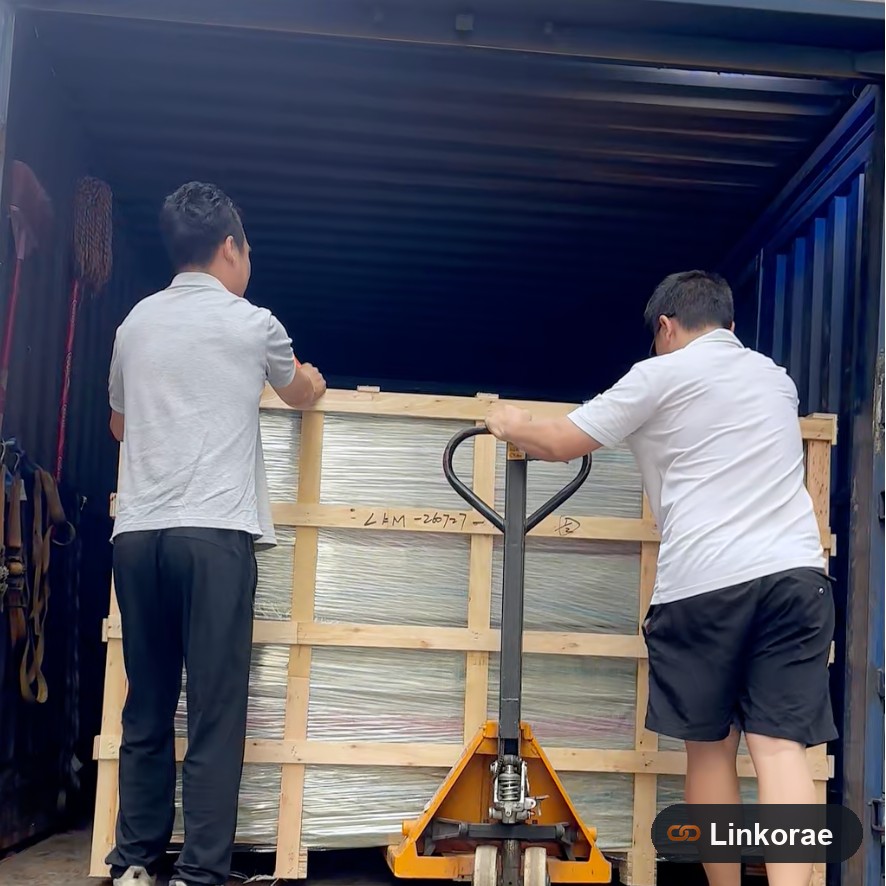
A shipment over 30 CBM that also contains individual pieces over 2 m generally has to be split across multiple bookings. This isn’t a fee — it’s a handling constraint — but it affects timeline and paperwork, so it belongs in the quote conversation rather than in a surprise email later.
4. Origin warehouse
Where you deliver to us in China affects the price:
- Shenzhen, Guangzhou, Yiwu — same rate, forklift handling included at no charge
- Xiamen, Foshan, Qingdao — inland transfer surcharge of roughly $0.10 per kg
On a 3,000 kg shipment that’s around $300. Worth checking before you decide where your factory ships to.
The charges that appear after booking
Below is an honest list. We’ve grouped them by what triggers them, because the trigger is the part you can control.
Triggered by paperwork
| Charge | Trigger |
|---|---|
| Separate customs declaration | Shipment declared on its own rather than consolidated |
| Extra product line items | More than 5 distinct product names on one declaration |
| Fumigation | Solid wood packaging or wood content requiring ISPM 15 treatment |
| Warehouse return | Cargo withdrawn from our warehouse before departure |
These are all fixed, predictable, and quotable up front. Ask for them at quoting stage and we’ll give you exact numbers.
Triggered by the delivery address
Forklift call-out, flatbed service, inside delivery, limited access, inside-gate access, redelivery, detention, weekend delivery.
These are third-party carrier charges assessed at or after delivery. We pass them through at cost plus handling and show you the carrier invoice. The full breakdown and thresholds are in the US delivery guide.
Why we don’t quote these as fixed prices: several are assessed by the trucking company after the fact, sometimes based on GPS location. Committing to a fixed number for a charge we don’t control would be a promise we can’t keep. What we can do — and do — is tell you before booking which categories your address is likely to trigger.
Triggered by the goods themselves
High-tariff items, anti-dumping categories, products requiring certification, single-use items, and goods with special industry functions all carry additional handling. Declare these before shipping. If we find out at customs, the cost is higher and the delay is longer. How duty sits inside a DDP number: is Section 301 included in your DDP price?
Customs inspection: the cost nobody quotes
If US customs pulls your container for examination, the hold typically runs 7 to 21 days, sometimes longer. There is no compensation for the delay — not from us, not from the carrier, not from customs.
What causes it, in rough order of frequency:
- Declared description doesn’t match actual goods. This is the big one and it’s entirely preventable.
- Product category flagged for the origin
- Random selection
- Prior history on the importer or shipper
If your declaration is inaccurate, responsibility and cost sit with the shipper. We’ll help with documents and communication, but we can’t absorb the consequence of a wrong declaration.
Packaging requirements that reduce inspection risk:
- Outer cartons must be export-grade material
- “MADE IN CHINA” on both the outer carton and each product
- Wooden crates must be properly hinged and sealed
- Yellow and black packing tape are refused at our warehouse — both are associated with tampering and attract attention
Cargo compensation: read this before you decide
We’d rather tell you this in an article than in an email after something breaks. Standard compensation on this service is limited:
- Loss before the goods enter the destination network: compensated by weight at roughly $6 per kg, freight not refunded
- Damage: not compensated
- Loss after handover to the destination carrier: per that carrier’s published claims process, capped at $100 per shipment
- Force majeure — earthquake, typhoon, severe weather: not compensated
- Loss or seizure arising from IP infringement: not compensated
For a pallet of furniture worth $8,000, weight-based compensation is not a meaningful remedy.
What we recommend: if your shipment value exceeds roughly $5,000, buy separate cargo insurance. It’s typically a fraction of a percent of declared value and it’s the only thing that makes you whole on damage. We can arrange it or you can source it yourself — either is fine, but don’t skip it and assume the standard terms will cover you.
International ocean freight is a loss-covered, damage-excluded service by default across the industry. This isn’t specific to us. Pack fragile goods accordingly, and insure what matters.
What we won’t carry
We refuse the following outright, and we check: counterfeit and brand-infringing goods, prohibited items, loose powders, liquids, food, pharmaceuticals, flammables and explosives, antiques, items restricted by carriers or shipping lines, rare metals and certain wood products.
If prohibited goods are found in our warehouse, the shipment is not returnable, a penalty applies, and the matter goes to the authorities. If customs finds them, we bear no liability and reserve the right to recover our losses.
We say this plainly because ambiguity here helps nobody. If you’re unsure whether your product falls into one of these categories, ask before you ship. A five-minute conversation is cheaper than a seized container. Broader rules on what moves: what can and can’t you ship from China to the US?
Five questions to ask before you accept any quote
Ask these of us, and ask them of every other forwarder you’re comparing. The answers are where the real price difference lives.
- What is the longest single dimension you’ve quoted for, and does the price change above it? Length surcharges are tiered. If your quote was built on 290 cm and your crate measures 310 cm, the price changes.
- What is the heaviest single piece, and will the driver unload it? Over 400 kg or over 2 m and the answer is no. Find out now whether you need a forklift.
- Is this address classified as limited access? Construction sites, gated communities, trade show venues, ports, government facilities — all flagged. Ask them to check the specific address, not the address type.
- Which compliance documents am I responsible for? Get a written list. “We’ll handle it” is not a list.
- What is the compensation if the goods are damaged? For most ocean services the answer is “nothing.” Better to know before you ship than after.
How we quote it
We ask for four things before we give a number:
- Delivery address — determines truck type and access charges
- Heaviest single piece and its weight — determines unloading requirements
- Dimensions after palletising — determines truck assignment and length surcharges
- Product description and HS code — determines duty and compliance requirements
Those four data points determine roughly 90% of what your shipment will actually cost. A forwarder who quotes without asking for them is either guessing or planning to adjust later.
We’d rather have a longer conversation at quoting stage than a shorter one at delivery.
Want a quote that won’t move?
Send four things: delivery address, heaviest single piece with weight, dimensions after palletising, and your product description. We’ll give you a number and tell you which additional charges could apply. Free, no obligation. Mon–Sat, 08:00–22:00 China time (GMT+8).
Surcharge names and triggers vary by carrier and lane. Figures verified August 2026. This is general information, not legal advice.